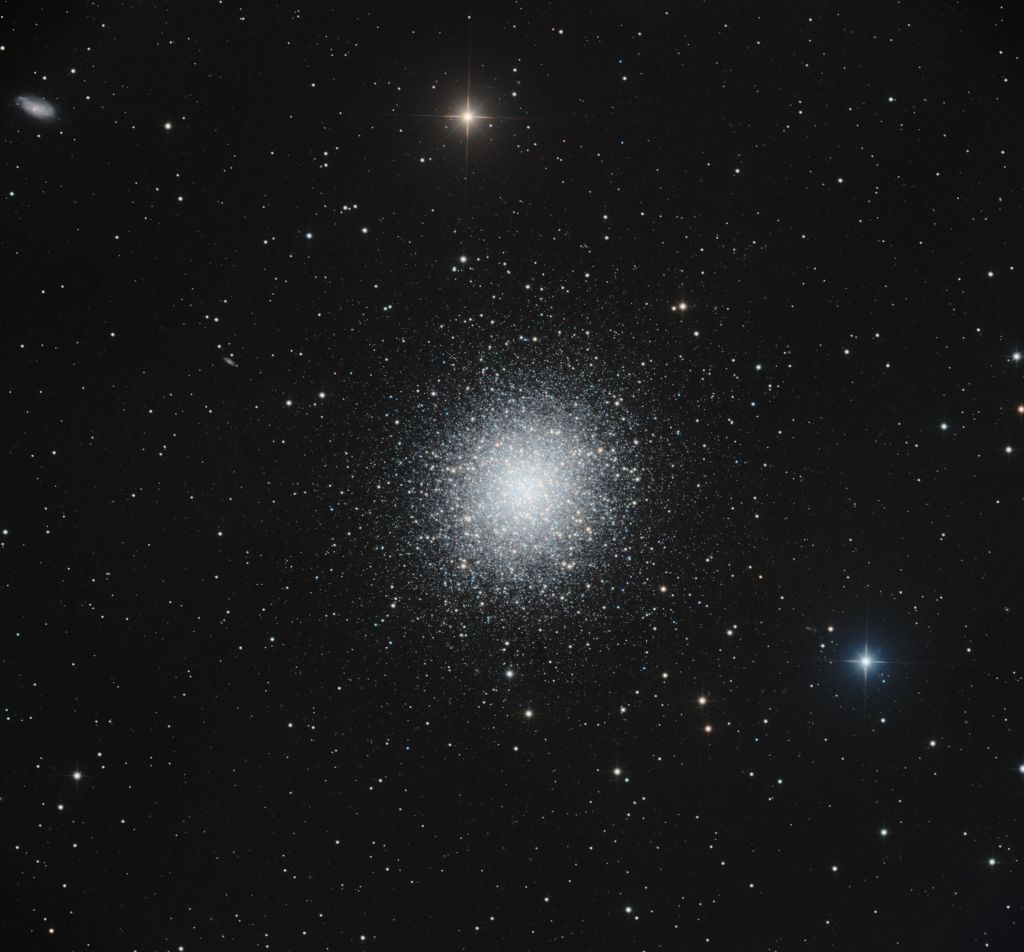
Messier 13 is one of the jewels of the northern sky. It’s a globular cluster in Hercules and if you are an amateur astronomer who has access to that part of the sky, it’s one of the first deep sky objects you saw through a telescope if that happened in the late spring through summer.
M13 fills a sphere with a diameter of roughly 128 light years and packs several hundred thousand stars into that space. By comparison, the same volume in our part of the Milky Way probably only contains a few hundred stars. If there are any planets around those stars in M13 they are sure to have a very bright night sky! The odds may be against those planets existing though since these are old stars that have low metal content and so may not have had the raw material to make planets. If they do exist it’s likely an unhealthy place to live.
The cluster is about 220,000 light years away and has an apparent size about ⅔ of the full moon. It’s got a magnitude of 5.8 making it an easy binocular object and even bright enough to perceive as a somewhat fuzzy “star” with the unaided eye in a very dark sky.
This is 12h 15m of LRGB data. For all the technical details, see astrobin.
 Linda's Astronomy Adventures