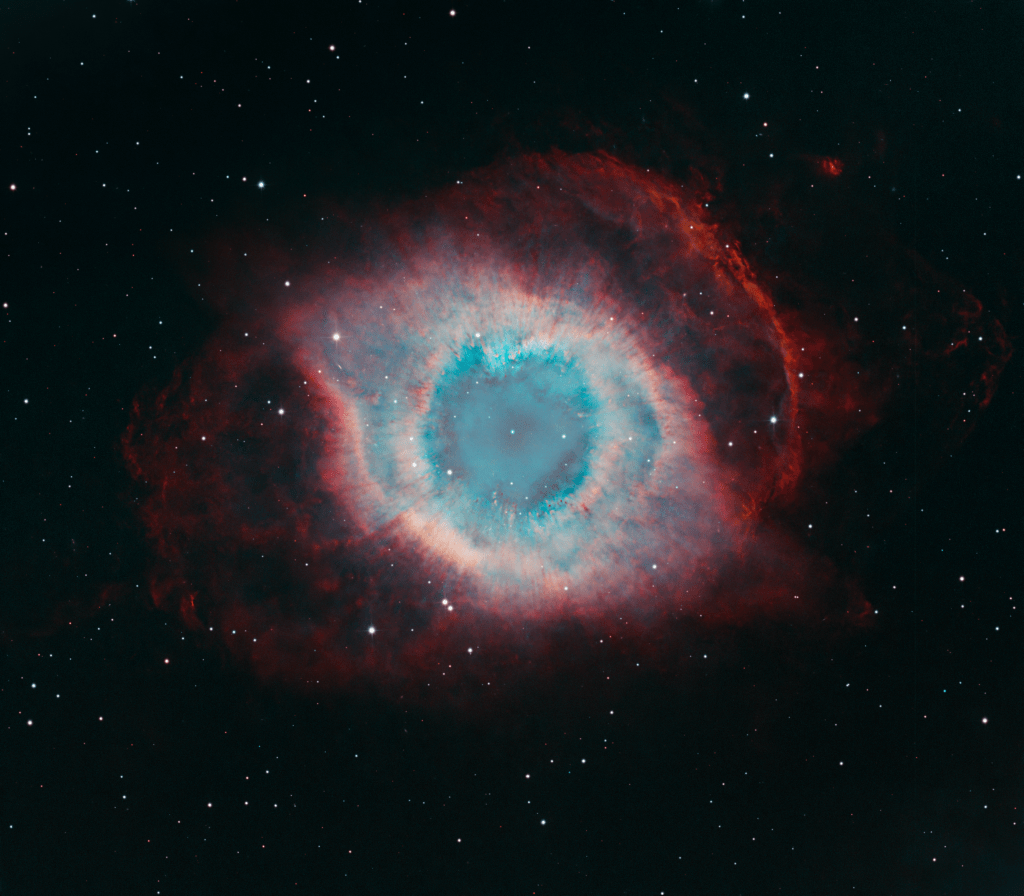
The image above is a reprocessing of the Helix data in the HOOSY palette (HOO with S in Yellow). It also uses some HDR techniques to show more detail in the nebula itself. The two images give very different feels. I find I like them both for different reasons.
The original image is below:
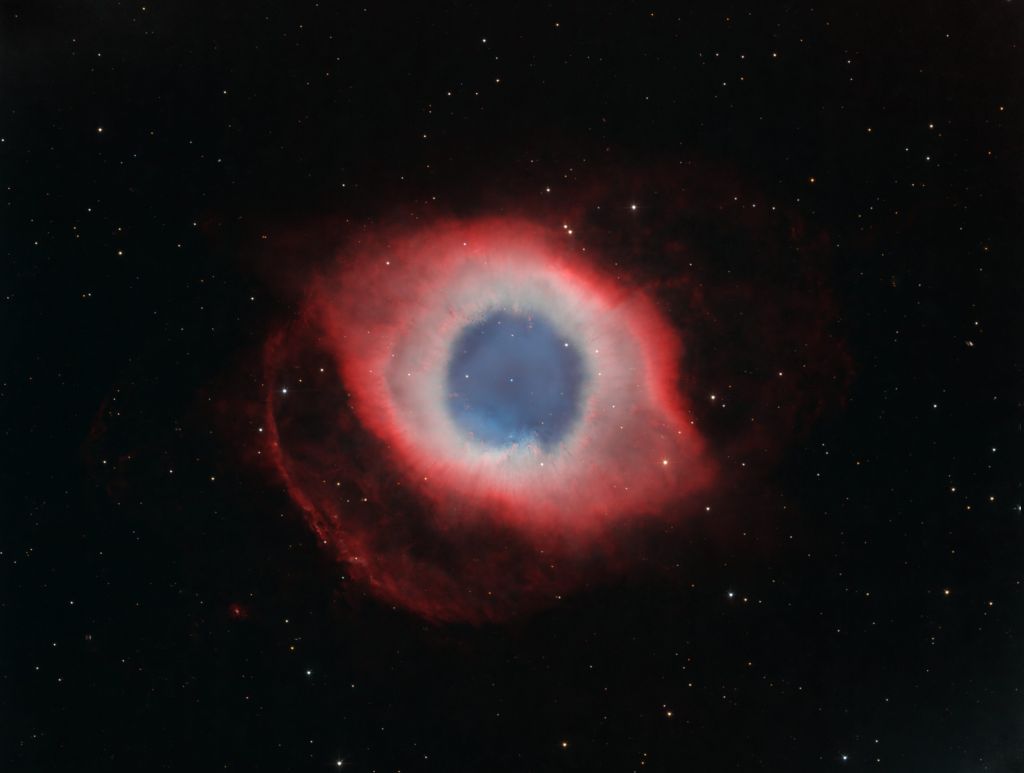
The Helix nebula has been called the Eye of God or the Eye of Sauron but seems to me it is more like the Bloodshot Eye. Whatever name it goes by, it’s in the catalogs as NGC 7293 and Caldwell 63. It is a planetary nebula in Aquarius.
This is an HOO image with hydrogen alpha in red and oxygen III in green and blue. The stars were from RGB data so overall this image approximates natural color for the nebula and has natural color for the stars.
The Helix is one of the closest planetary nebula to Earth at about 655 light years away. Since planetary nebula are relatively small in an absolute sense they also tend to have small apparent sizes due to their distance. But, since the Helix is so close it ends up being relatively large to us. bright core is about ⅔ the size of the full moon and the faintest extents visible are a bit larger than the full moon. For a planetary nebula that’s a lot of sky!
This must be one of the closest, if not the closest deep sky object I’ve imaged. Normally I think of a few thousand light years as fairly close but this is the stellar equivalent of just a couple blocks away.
This is 45h 45m of HOO data + S in the Lum channel with RGB stars. You can find all the technical details at astrobin.
 Linda's Astronomy Adventures