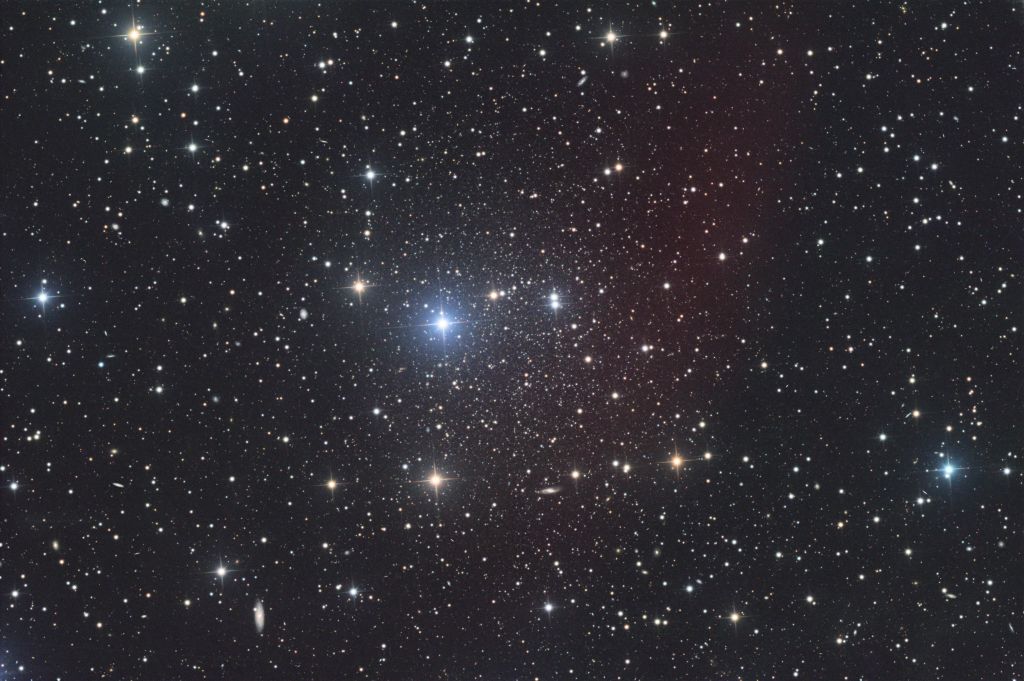
The southern hemisphere gets the spectacular Magellanic Clouds and we northerners have to settle for the anemic, faint, Draco Dwart Galaxy. It’s faint and diffuse and doesn’t much look like a galaxy. It’s the denser concentration of stars in the center. It’s so diffuse you can see more distant galaxies behind it shining through.
But, for all of its lack of visual splendor, it’s an interesting place. It’s about 260,000 light years away. Somehow it’s lost almost all of its dust (a good part of why it doesn’t much look like a galaxy). It’s considered a spherical galaxy and it’s a satellite galaxy of our Milky Way. It’s full of old, low metallicity stars much like a globular cluster and, to me, it looks a bit like a very sparse globular cluster, but it covers a much larger volume. I wonder if the Milky Way has stripped away much of its dust but that’s just speculation on my part. It is also thought to have an exceptionally high amount of dark matter.
The other mystery in this image is that red “swoosh” just right of center. It’s not from hydrogen-alpha emission. We took four hours of hydrogen alpha data for this and the integration was completely empty of anything except for stars. However, the “swoosh” shows up on some (though not all) red and luminance subs. I’ve looked for it in other images and it doesn’t appear in any that I’ve found. It could be a local light source. I’m ruling out a reflection from a thin high cloud as it’s in the same spot on all the subs even across a few weeks so if it’s a local source it’s somehow in the same orientation to the telescope and that’s something that clouds are unlikely to produce. When I inspect the subexposures, I don’t see anything wrong with them so it’s possible it’s real but just what is could be is a mystery given that it isn’t hydrogen-alpha. If it’s a real emission of some sort then it’s almost certainly in our galaxy (so between us and the Draco Dwarf Galaxy) even though the image gives the impression it’s in the background.
Speaking of the background, there are lots of distant galaxies (and more interesting visually interesting) in the frame.
So, the Draco Dwarf Galaxy is a place of many mysteries.
This is 55h 30m of LRGB data. You can find all the technical details at astrobin.
 Linda's Astronomy Adventures