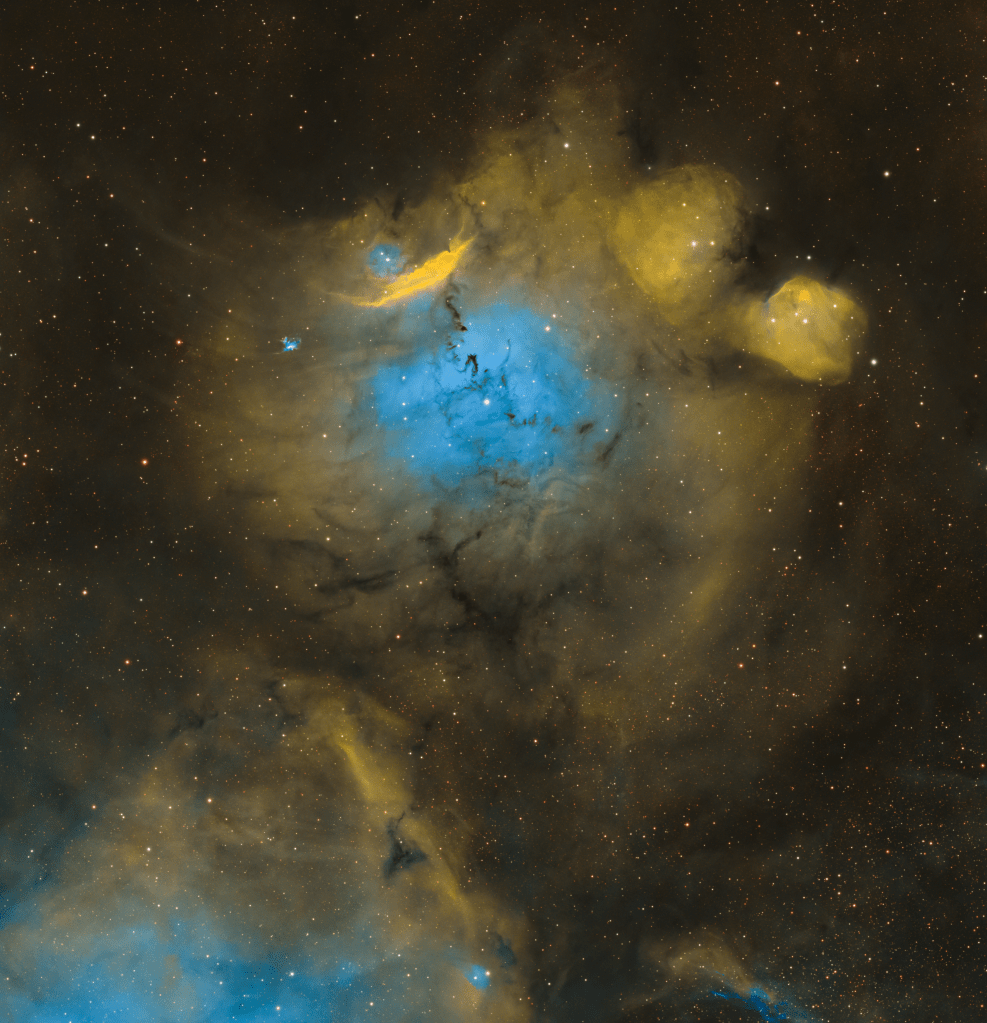
The collection of catalog numbers make up an emission nebula in Sagittarius. Normally, this region is so full of stars that they can overwhelm the subject but I kept them deliberately a bit toned down to help the nebula shine through.
NGC 6559 is the “swoosh” while IC 4685 is the central blue region. IC 1275 and 1275 are the yellow puffy cottontails in the upper right. Though there are four entries from two different catalogs it looks like this is all one cloud though it’s possible that NGC 6559 is enough in front to he other cloud that it is separate.
NGC 6559 is about 5,000 light years away but I couldn’t find data on the other catalog entries. If they are part of the same cloud then it should all be about the same distance.
This is an SHO image, also known as the Hubble palette. The idea is to put the data from the three narrowband filters into the red, green and blue color channels in the same wavelength order so S II, being the longest wavelength goes in red, hydrogen alpha being next shortest goes in green leaving O III for blue. This, however, produces an overwhelmingly green image since hydrogen produces a much stronger signal because there is 10 to 100 times more hydrogen than anything else. In this image, I took the common route of simply subtracting the green which leaves a bicolor blue/gold image. The blue is where oxygen is and the yellow/gold is where both sulfur and hydrogen are.
This is data from 2022 provided by a friend taken from the same observatory in Texas I’ve been fortunate enough to use the last few years. This is 46h 30m of SHO data. For all the technical details, see astrobin.
 Linda's Astronomy Adventures