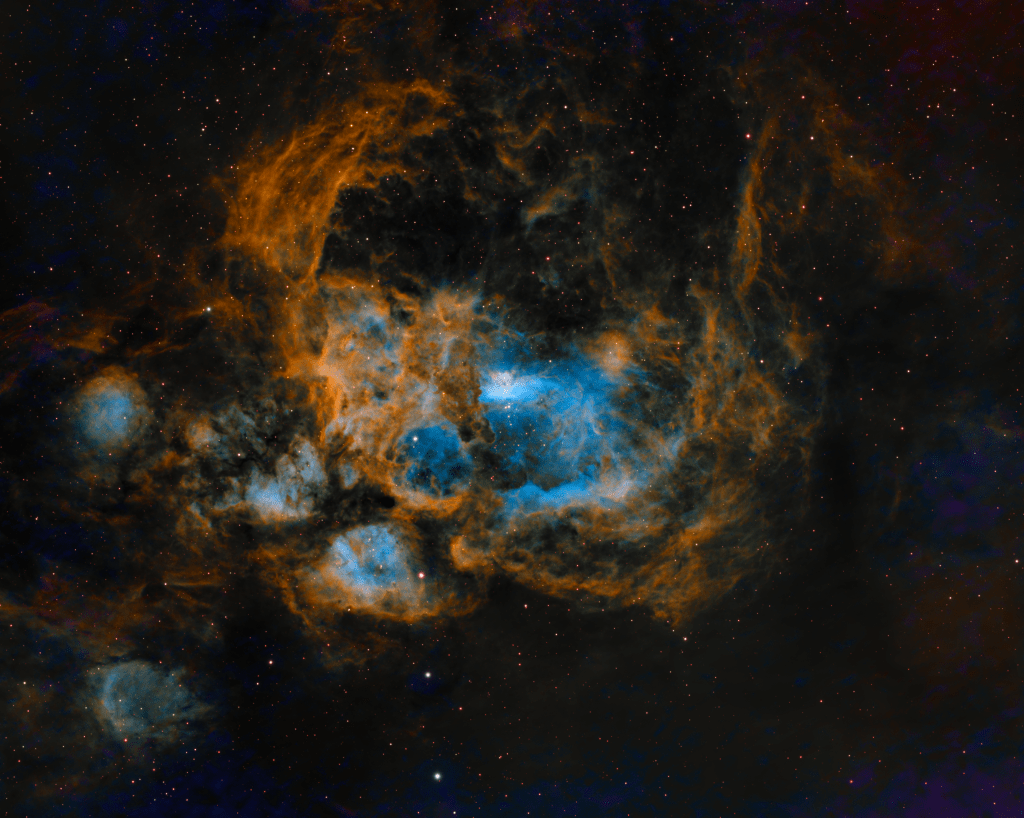
NGC 6537 has a bunch of catalog designations: War and Peace Nebula, Lobster Nebula, Sh2-11, Gum 66, and RCW 131. There may be others. This one seems to collect names. When I choose a name to label things, I try to go for the most common, unambiguous name leaning towards common names over catalog designations (except for the Messier catalog) since the catalog designations can often be for parts of what show up in the image. Really, I’m probably spending too much time worrying about something that doesn’t bother anyone but me, but this is what happens when you have someone who probably could have been a happy librarian living in my brain, trying to get out.
Enough about me, on to the nebula. This is an emission nebula in Scorpius. It’s about 5,900 light years away.
Processing this one was a challenge both because of an issue with the data and based on what I’ve seen of other people’s image so this, the nature o the nebula itself. The image tended to look over processed even though I was trying to treat the data fairly gently. Though there was a lot of data, it suffered from what is known as walking noise. It gets called that because it looks like diagonal lines that run through the image. It’s caused by feed pattern noise in the sensor. We move the telescope slightly between exposures so this fixed pattern noise doesn’t line up and that helps the processing software remove it. If the movement (called dithering) isn’t big enough then the noise doesn’t get rejected properly. And, unlike random noise sources, noise reduction software doesn’t work on this because it isn’t random. It means the data puts a lower limit on how much processing it can take. Fortunately, I was able to suppress that noise but I think it may have been a contributing factor to that perceived “crunchiness”.
Even so, this was an interesting nebula to process and one I wasn’t familiar with. The data was provided by a friend from a telescope in Texas. He imaged this in 2022 and he and our team in Texas decided to share data. This is 79h 10m of SHO data. For all the technical details, see astrobin.
 Linda's Astronomy Adventures