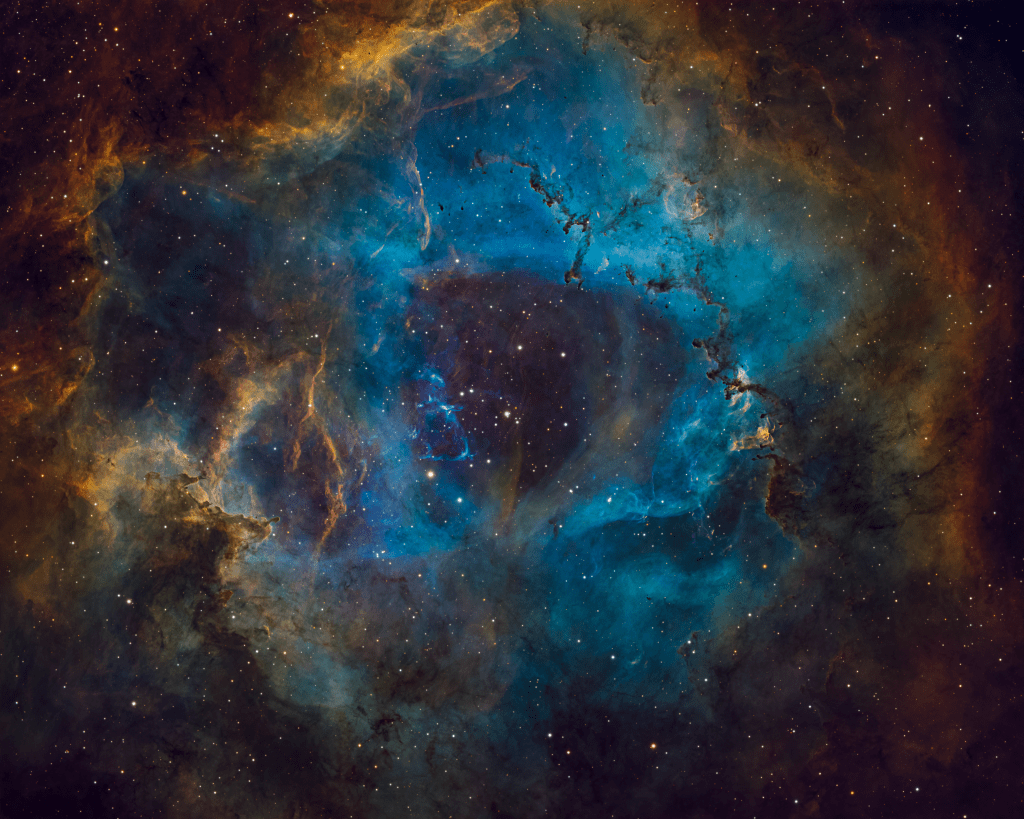
The Rosette Nebula was the first narrowband image I did back in January of 2020. Given the freedom of being able to make the color be whatever I wanted, I went a bit wild. I hadn’t returned to the Rosette but a friend supplied me his data and it was over 100 hours worth, I had to give it a try. On the surface, this seems like overkill given how bright the Rosette is. And, since the Rosette is larger the field of view, we don’t get the benefit on the faint outer edges that a deep integration would provide. Even so, this was very easy data to process. There was plenty of signal in all three masters so there wasn’t a need to try to coerce detail out of the noise.
I don’t normally go for images this saturated but this time, it worked for me.
The Rosette Nebula (AKA Caldwell 59) is an emission nebula in Monoceros. At its center is open cluster NGC 2244 (Caldwell 50). Curiously the Rosette doesn’t have an NGC number but four (not counting the open cluster). Parts of it were each given an NGC number which probably says something about the quality of the telescopes of the time that couldn’t tell it was a single cloud.
Both the nebula and open cluster are about 5,000 light years away.
This is 101h of SHO data. For all the technical details, see astrobin.
 Linda's Astronomy Adventures