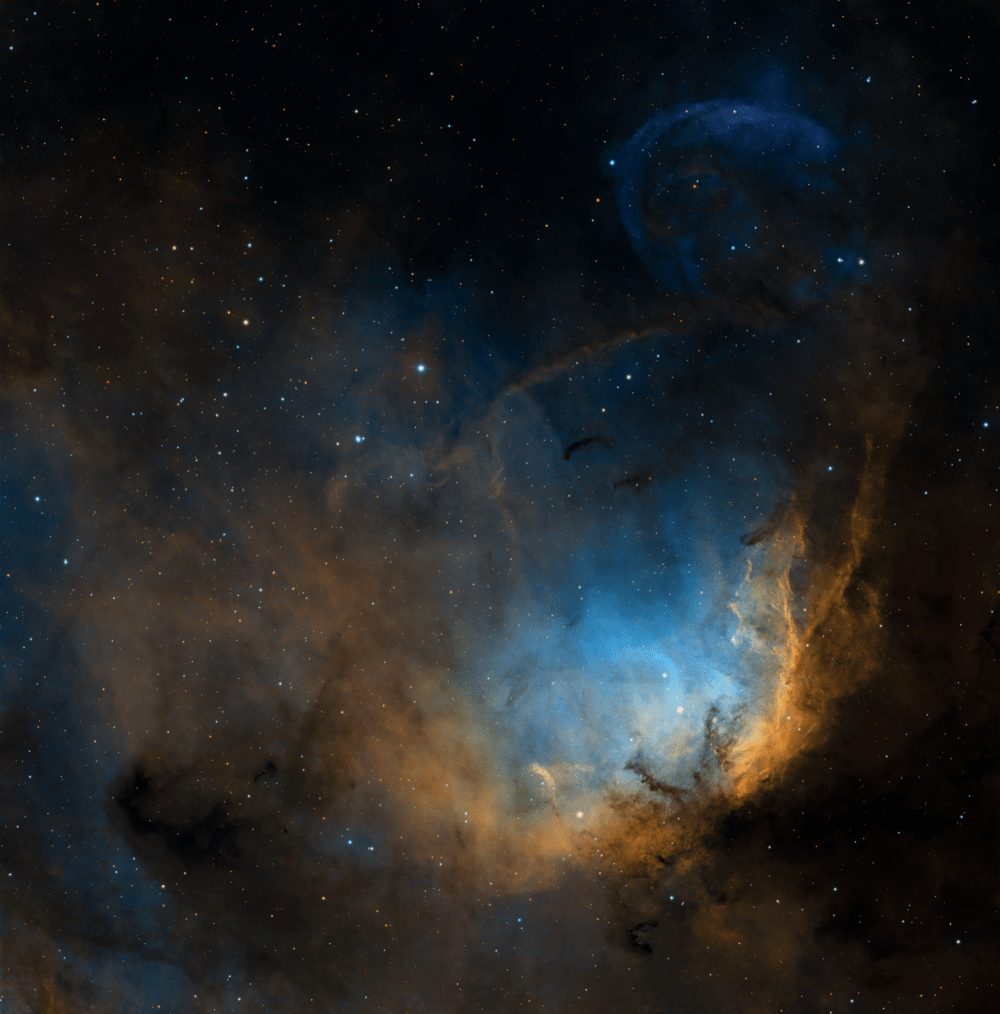
This is a two panel mosaic of the Tulip Nebula and the bow shockwave from the Cygnus X-1 black hole. The left panel is from the earlier Tulip Nebula image posted recently and the right half containing the bow shock is new.
I have this rational fear of mosaics. I say “rational” because I think it makes sense to be afraid of the complexity they create. In this case, the two panels needed joining across six different filters. It’s easy for something to go wrong and that complexity seems to scale non-linearly with each added panel. Fortunately, this was just a two panel mosaic and it went together without any problem. I was disappointed that the previous Tulip Nebula image did not have a field of view wide enough to contain the Cygnus X-1 bow shockwave but it wasn’t until a teammate suggested we do the mosaic that I even considered doing anything other than living with my disappointment. I’m really glad he did make the suggestion! Despite my fears, this worked out wonderfully and this might be one of my favorite images!
The Tulip Nebula (Sh2-101) is an emission nebula in Cygnus. It’s about 8,000 light years away.
Cygnus X-1 is an x-ray source discovered in 1964. It was the first detection of a black hole though it took time to prove that. The black hole is part of a binary pair with a blue supergiant star. Stellar wind from that star gets pulled into an accretion disk around the black hole and that causes x-rays to be emitted. The jet that comes off the accretion disk eventually runs into the gas in the interstellar medium and that creates the blue shock wave arc we see. This is probably about as close as an amateur can come to imaging the area around a black hole.
The black hole is estimated to contain a bit over 21 solar masses and its event horizon is only 600km in diameter. It’s about 7,000 light years away so even with an extended accretion disk around it, it would be far too small to image. But that shock wave extends for light years.
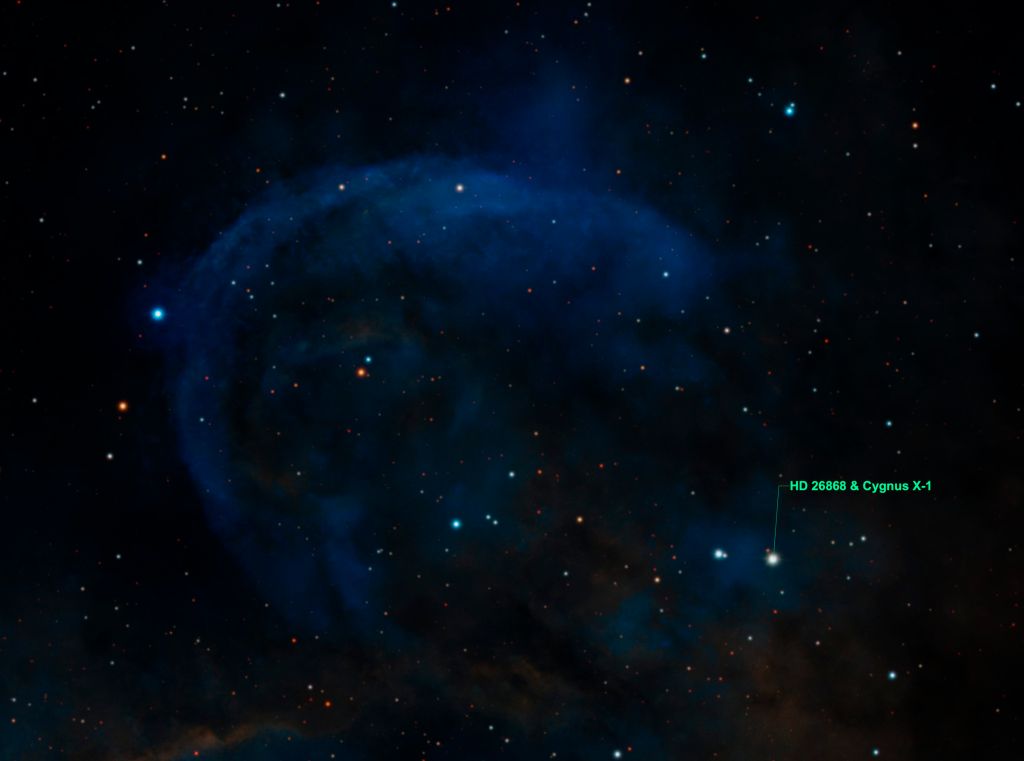
This is a crop of the image above and highlights the star, HD 26868 that is part of the binary pari with Cygnus X=1. The black hole is only about 20% of the distance from its companion star, HD 26868 that the Earth is from the sun
This is 65h 45m of SHO and RGB data. For all the technical details, see astrobin.
 Linda's Astronomy Adventures