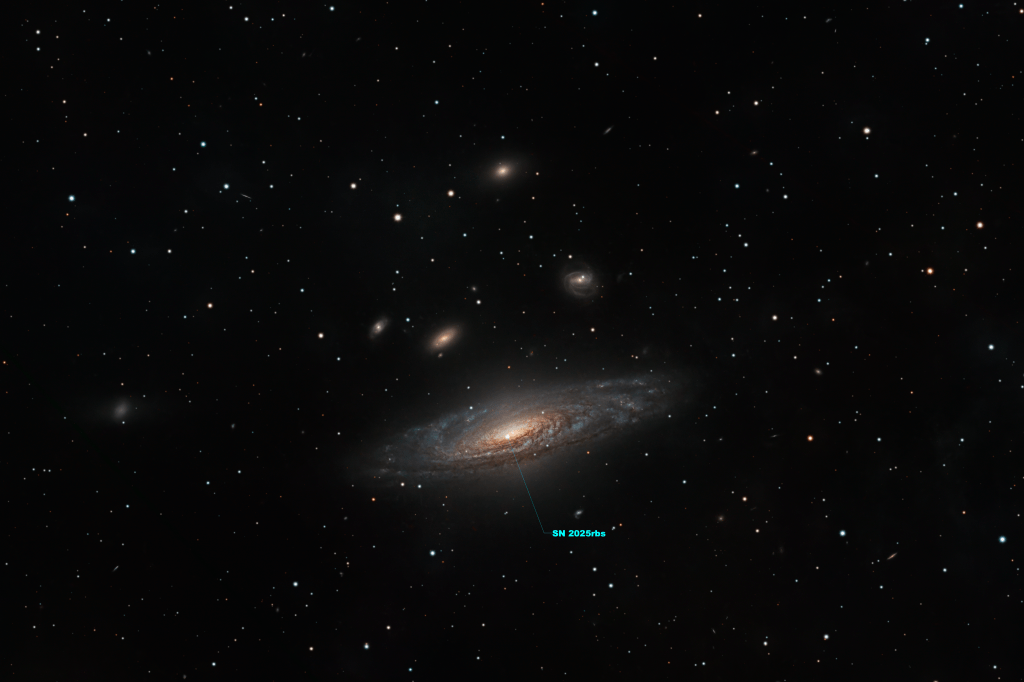
On July 14, 2025, the GOTO telescope array discovered a supernova in the galaxy NGC 7331. NGC 7331 is the most prominent member of a group of galaxies called the Deer Lick Group. The galaxies above NGC 7331 in this image are known as The Fleas. The Fleas (NGC 7335, NGC 7336, NGC 7337 and NGC 7340) are about 350 million light years away.
This is the constellation of Pegasus.
NGC 7331 is about 40 million light years away. The white dot you see near the center of the galaxy that looks like a foreground star is the supernova. Something has to be incredible bright to show upas a distinct object from that distance. At discovery, the supernova had a magnitude of 17.07. The integrated light of the entire galaxy (before the supernova) was magnitude 10.04. Since each magnitude number is 2.52 times dimmer than the previous number, the supernova is about 1/650 the brightness of the entire galaxy. That doesn’t sound like much but when you consider that the galaxy contains an estimated 1 trillion stars, that supernova is about as bright as 1.5 billion stars!
The supernova was classified as a Type 1a supernova. That occurs when a white dwarf somehow accretes enough material from a companion star the core of the star becomes hot enough to restart fusion. Unfortunately, it is a runaway reaction that causes the star to explode in a supernova. Unlike the supernovae from larger stars, this explosion completely disrupts the star without leaving a neutron star or black hold behind.
Because there is a fairly well understood limit to how large a white dwarf can be and therefore how bright in an absolute sense the supernova must be, astronomers can use Type 1a supernovae as “standard candles” to estimate distance.
Over time, the supernova will fade away and be lost to view but for now, it’s a bright reminder of the enormous energies that nature can throw around.
This is 8h 20m of LRGB data. You can find the technical details at astrobin.
 Linda's Astronomy Adventures