
There are a lot of stars in Cassiopeia and there are a lot of star clusters. This image holds six of them, five essentially in a line from bottom left to top right. Only two are obvious and three are there if you know what to hunt for while one doesn’t really stand out at all.
Here’s an annotated frame of what the camera was pointing at:
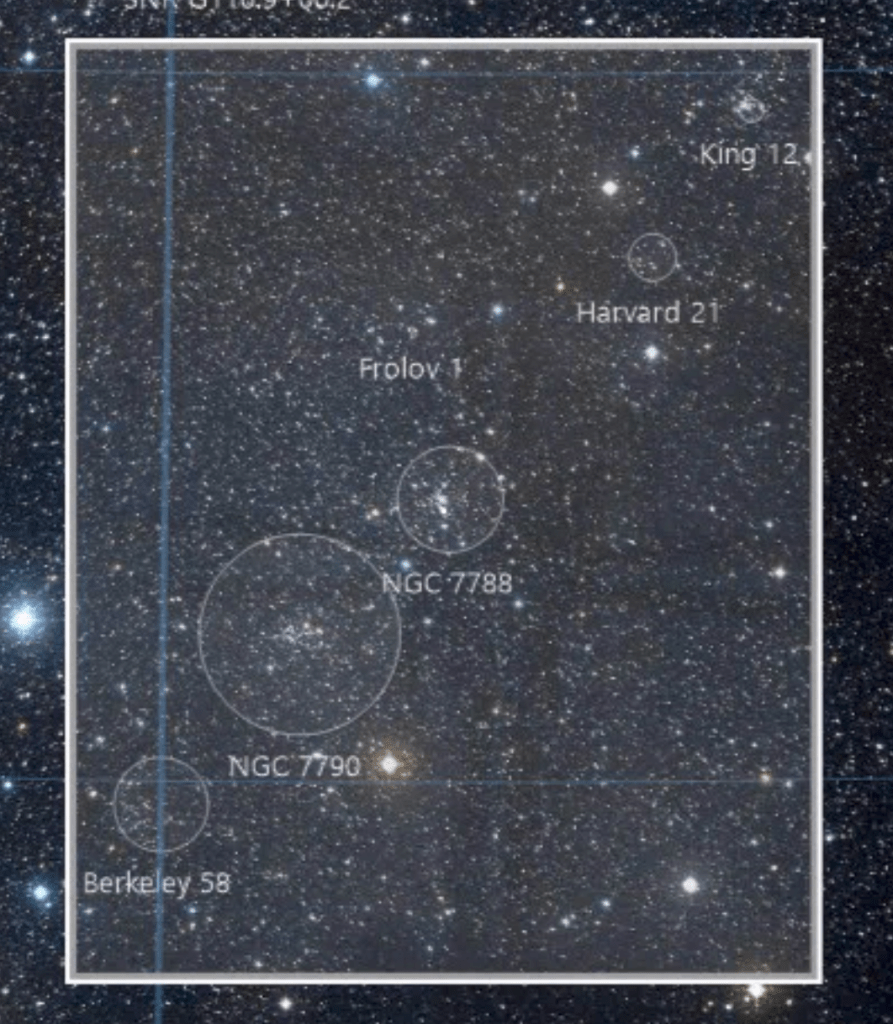
Each of those circles is around an open cluster – a collection of stars that were all “born” in the same nebula and are still gravitationally bound together. That means open clusters tend to be full of fairly young stars.
NGC 7790 is estimated to be about 10,800 light years away and its stare are thought to be 60-80 million years old – toddlers by star standards. NGC 7788 is estimated to be about 8,000 light years away and its stars are a bit younger at 30-40 million years. It appears the two clusters are not gravitationally related.
Berkeley 58 is around bit further away than NGC 7790 and slightly older but may be gravitationally connected to it. None of the other clusters appear to be connected gravitationally and the alignment is just a random line of sight alignment.
Frolov 1 is much closer and younger at 20-40 million years old and there is some debate as to whether its stars are really gravitationally bound. It’s possible that data from the Gaia mission may answer this question in the future.
Harvard 21 is the closest of the clusters and the oldest at 200-400 million years old – still young by stellar standards. King 12 is also very young at 20-30 million years old and more distant than anything by NGC 7790.
I was vague with distances for most of the non-NGC clusters as there are good references and though I asked ChatGPT what it knew, I don’t really trust it’s information.
I don’t normally take a lot of images of open clusters – I’m not good at doing them justice in the images compared to nebulae or galaxies but I couldn’t resist the chance to get a bunch of them in one field.
This is 15h of LRGB data. For all the technical details, see astrobin.
 Linda's Astronomy Adventures