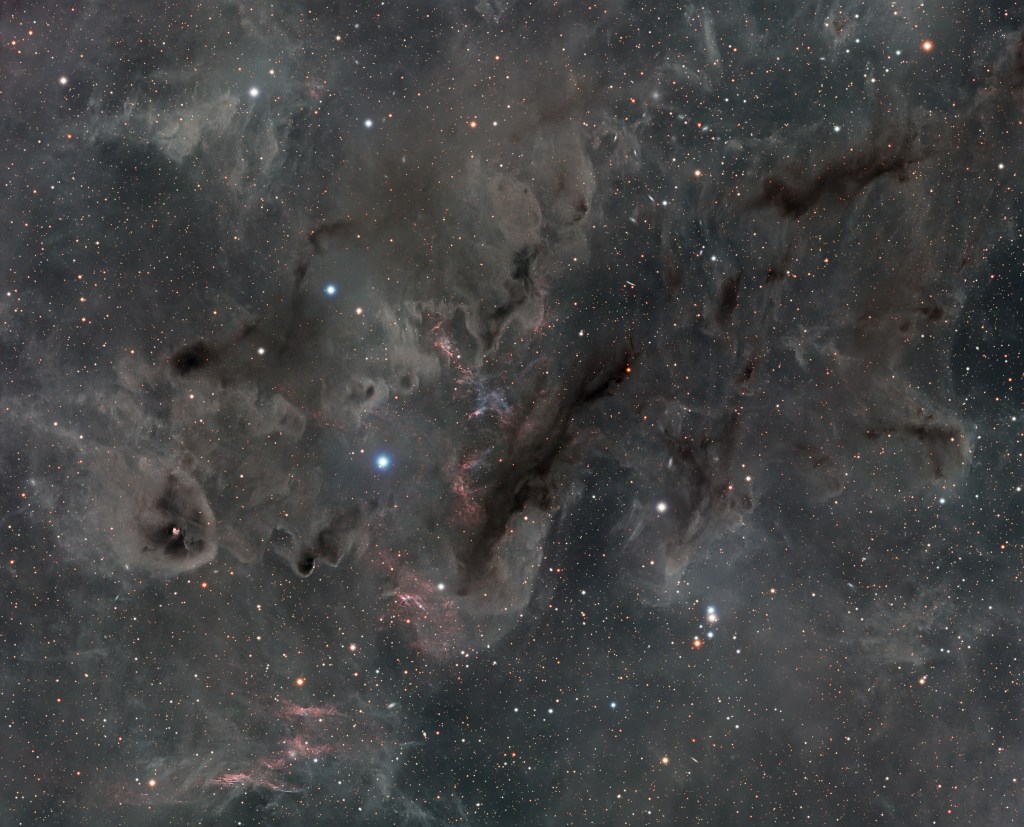
There’s a lot going on in this incredibly busy image. There’s a lot of dust clouds of various densities and there is also part of a very faint supernova remnant. The dust clouds are pretty obvious but the supernova remnant might be harder to see. The pink, filamentary structures in the bottom left going up toward the center are part of a much larger supernova remnant that extends well outside the frame to the top and left. There is some bluish oxygen emission from the supernova remnant visible in the center but the oxygen emission was incredibly faint. We dedicated 42 hours just to the oxygen but there wasn’t much of it and what there was was barely above the noise floor. As a result, there isn’t much to show of it.
Estimates on the distance to the dust clouds is around 2,500 to 3,000 light years. The supernova remnant is actually behind the clouds at 3,600 to 4,200 light years away. This is probably making the supernova remnant harder to see as the clouds are blocking much of its light. The supernova is estimated to have happened between 15,000 and 26,000 years ago. For comparison, the Crab Nebula supernova happened about 1,000 years ago and the Veil Nebula supernova is estimated to have happened around 10,000 to 20,000 years ago.
This was a challenging image to process, mostly the H and O filters which were intended to help bring out the supernova remnant. But, those emissions were so faint, especially, the O emission that they were very challenging to work with. From a practical perspective, the O was not time well spent though it was a fun experiment.
This is the longest single camera, non-mosaic integration I’ve worked on to date at over 117 hours. For all the technical details, see astrobin.
 Linda's Astronomy Adventures