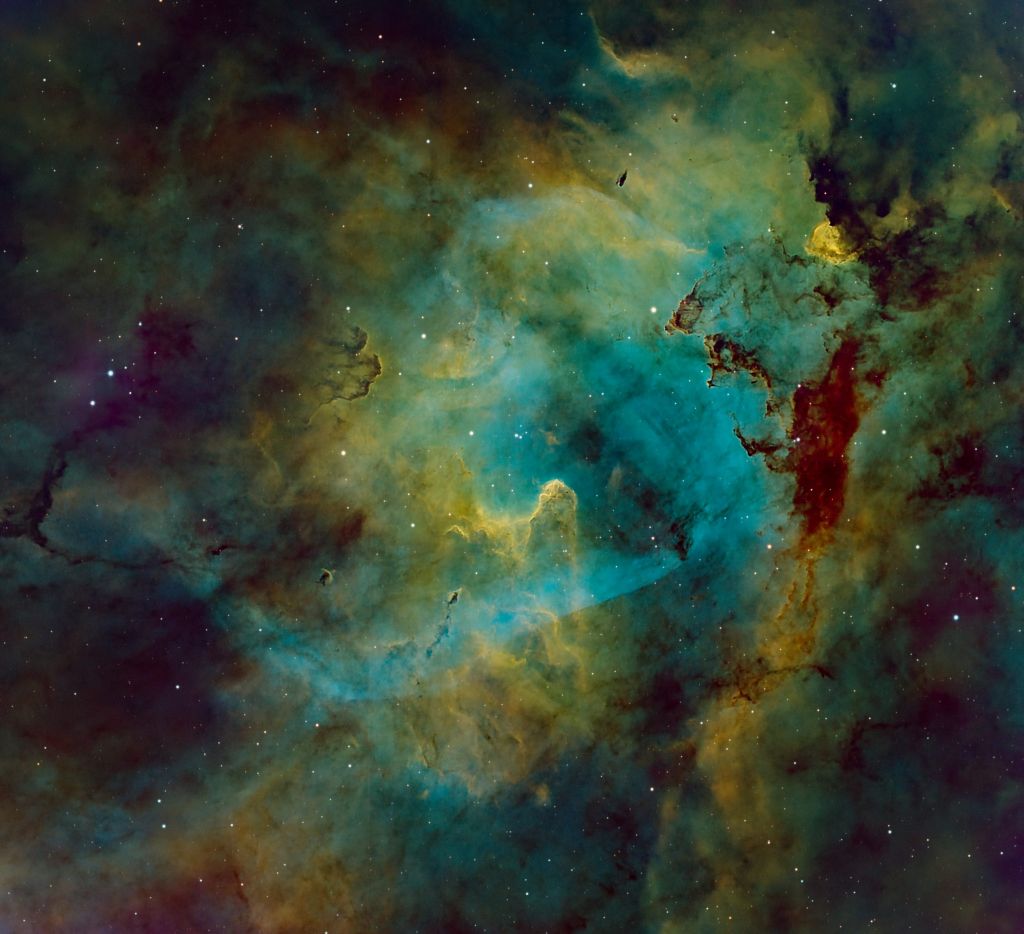
The Lion Nebula is an emission nebula in Cepheus. It is actually much larger than our field of view in this telescope/camera combination so this focuses on the brightest part of the nebula, the “head” of the lion. It’s also known as Sharpless 132.
This is actually a target our team did in 2021 but when I was entering some new targets in mid-summer, I added this again forgetting we had done it before. As it turns out this was a happy accident because the 2021 data wasn’t great. The telescope was probably fairly dirty and the sky conditions weren’t great because of smoke from California wildfires and though I was happy with the 2021 result, when I saw the improvement in signal in 2023 I was all in on a redo.
This is a combination of some of the 2021 data (a lot wasn’t worth keeping) and the 2023 data. In terms of signal weight, 2023 probably dominates as it is a much stronger cleaner signal. The total integration time was 87 hours making it one of the longer integrations I’ve ever done.
The nebula is about 10,000 light years away and is chock full of amazing detail. It looks like there are layers of different types of structures all mixed together. I wish I knew what caused that line of mostly hydrogen and oxygen to make such an abrupt turn. I don’t think I’ve seen a feature like that in another nebula.
For all the technical details, see astrobin. For the 2021 version see this.
 Linda's Astronomy Adventures