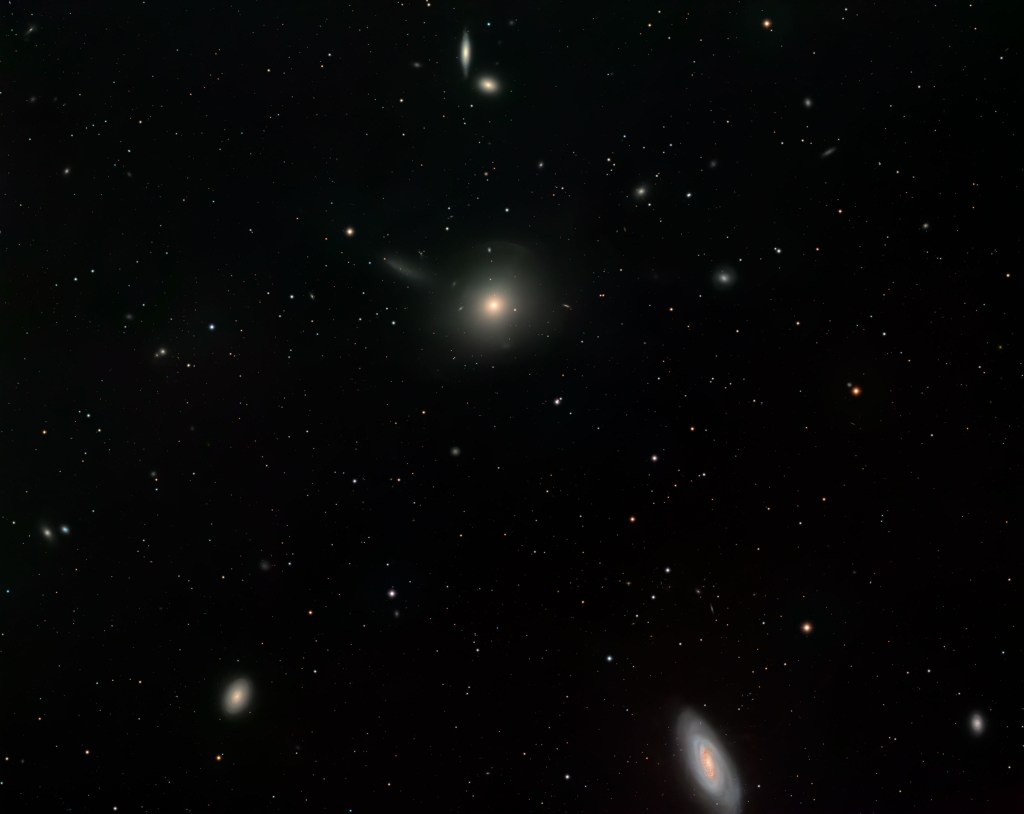
If you want to see galaxies, point your telescope at Virgo. There are more galaxies than you can count in that part of the sky. In this case, the main course is Messier 89, the elliptical galaxy just above center. There were so many interesting galaxies around it that it made framing challenging. I don’t think this is going to win any awards for composition but it does capture the sense of just how much interesting stuff is up there.
Normally, elliptical galaxies are not that interesting photographically speaking. They are round blobs of stars. However, this one has a huge tidal tail of stars poking up out of it. I don’t know whether these are stars that were drawn up out of M89 or stars from another galaxies that M89 merged with that are still hanging around out there but whatever the source it draws the eye in. At first I thought it might be a jet like the one coming out of M87 but when I looked closer that didn’t seem likely. Then I though it might be a more distant background galaxy or a small satellite galaxy but doing some further reading said it was a tidal tail so these stars are gravitationally associated with M89.
M89 also contains shells of material inside it so it’s had a lot of interaction and merger events in its lifetime. It’s definitely. not your father’s elliptical galaxy to paraphrase a car commercial from way back when.
M89 is around 50 million light years away.
Messier 90 is the largish spiral galaxy at the lower right. It’s about 58 million light years away
NGC 4531 is the smaller spiral galaxy in the lower left. it’s about 50 million light years away.
NGC 4550 and 4551 are the two galaxies toward the top. NGC 4551 is the lower of the two and is about 57 million light years away NGC 4550 is about 50 million light years away. Despite their apparent closeness, they do not appear to be interacting.
This is 28h 40m of HaLRGB data. For all the technical details, see astrobin.

