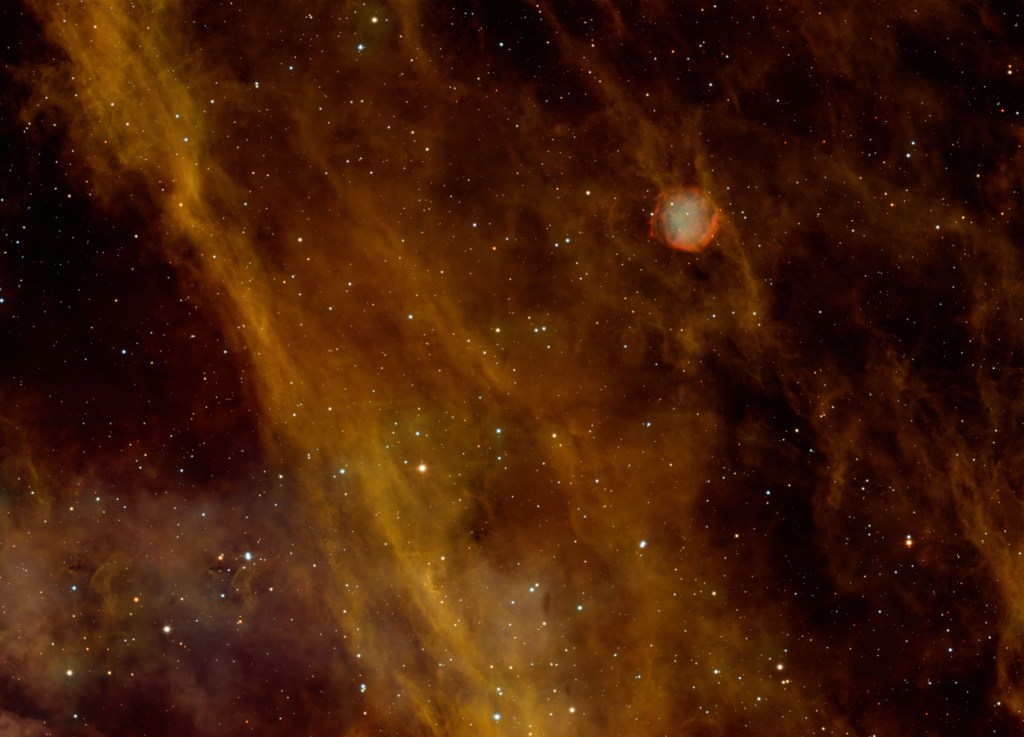
This is what happens when we get too complacent determining what a thing out in space is by looking at an image. When I saw this for the first time, I assumed that Sh2-116, the small blue and red circular object in the upper right was a planetary nebula. It looks like a planetary nebula. They tend to be small and roundish and oxygen tends to dominate over hydrogen and this fits that description perfectly. George Abell, who made a catalog of planetary nebulae certainly thought so.
Both of us, it turn out, are probably wrong.
Subsequent studies have determined that this is most likely an HII region. HII regions are large stretches of space with hydrogen gas. There’s usually other stuff – the bulk of this image is the nebula LBN 362 and it has lots of hydrogen but also oxygen and sulfur and probably lots of other things – but Sh2-116 has a (relatively) dense core of oxygen with a fringe of hydrogen. This is the way many planetary nebulae look. So why does this look that wan and isn’t a planetary? I’ve got no idea. Sorry about that. It’s an intriguing mystery, at least if you find mysteries about why this blob of gas that isn’t a planetary is structured like one intriguingly mysterious.
The wider region is most of the nebula called LBN 362. It’s mostly hydrogen with a smattering of oxygen and some sulfur. I’ve boosted the sulfur here to make it more obvious. It’s what gives the image that golden hue. In reality this would all be red and blue and mostly red. But, by doing this we can make a prettier picture and also make the structure easier to see.
This image is in the HOOSY palette. That’s hydrogen in red with oxygen in green and blue. Sulfur is then layered on as yellow. It is 43h 30m of HOOSY with RGB stars. For all the technical details, see astrobin.

